
Who is Lamia?
LamiaBréchet Ighil
behind “Lamia Femme Berbère”
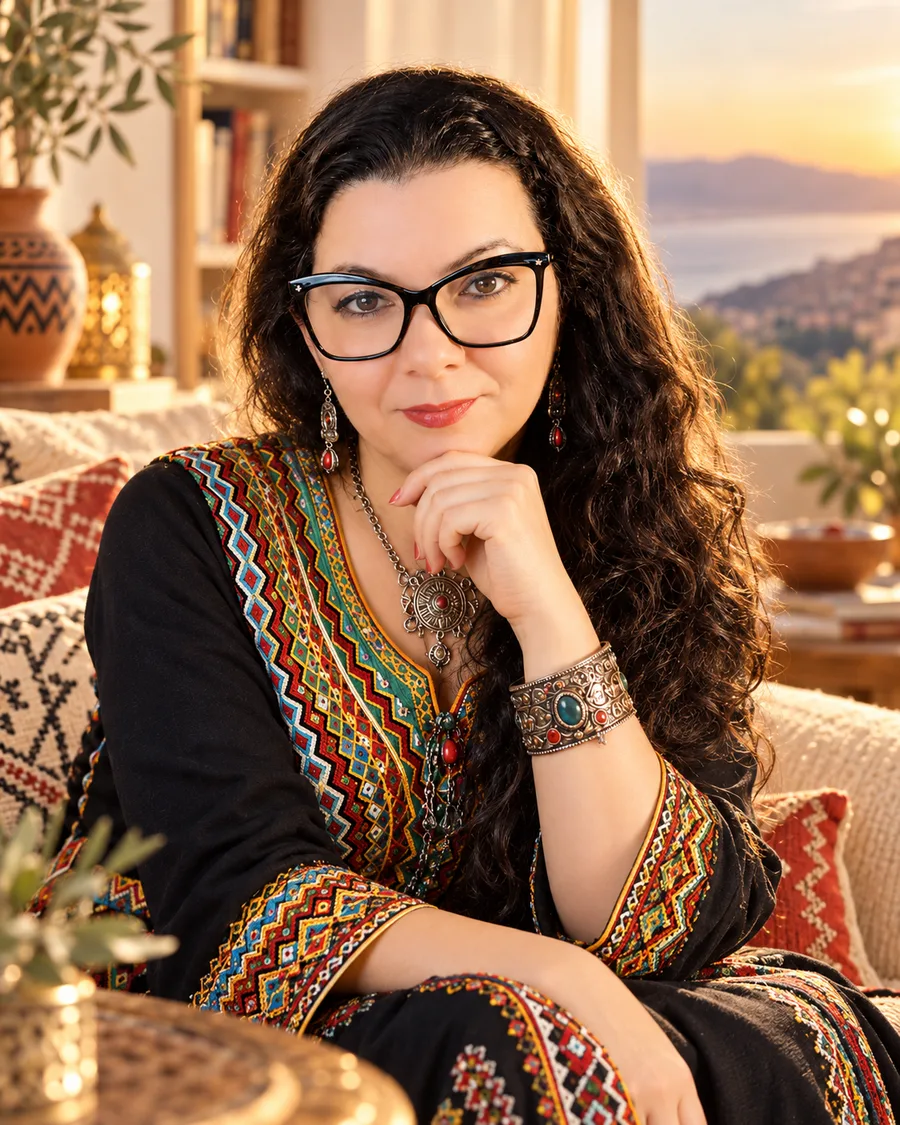
My name is Lamia Bréchet Ighil.
If you already know me, chances are we met on a screen: in a live, a video, a debate about couples, marriage, single life… or in one of those conversations that start out very serious and, five minutes later, have everyone bursting out laughing.
Lamia Femme Berbère is me, but it’s not just my name on social media.
It’s a way of seeing, a voice, a community and now a House.
I talk about love and marriage, of course. But also about society, human relationships, contradictions, passing things on, and everything that makes up our lives between several cultures, several generations and several ways of seeing the world.
And I like to do it with one fairly simple rule: you can talk about serious things without becoming gloomy or preachy.
I
It all started with talking
Before the books, before the jewellery and before the House, there were conversations.
The lives became my living room.
We talk about single life, love, marriage, choices, behaviour that makes us laugh or makes us wonder, what we expect from a man or a woman, traditions we want to keep and those we sometimes feel like shaking up.
I’m not trying to hand out good and bad marks. I’d rather ask the question nobody dares to ask, listen to the answers, compare points of view and sometimes say what everyone is thinking.
With humour, but never without respect.
That’s also why many people who come for a debate end up staying for the atmosphere, the connections and the community.
II
“ Lamia Femme Berbère ”, between heritage and life today
I’m deeply attached to Kabyle culture and what it passes on: family, stories, jewellery, symbols, the words of our elders, and that particular way we have of laughing at ourselves too.
But I don’t want to lock this culture away in a display case. A culture lives when you carry it into the present.
That’s the idea I try to bring to life in everything I create: getting heritage and modernity, Kabylie and France, traditions and personal choices to talk to each other.
No forced folklore.No compulsory nostalgia.Without asking anyone to choose one half of themselves.
III
Yemma Werdi was born from these conversations
From talking with young women about their encounters, their doubts, their whirlwind romances and sometimes their nasty surprises, another voice appeared: Yemma.
The mother who listens before judging. The one who can tell you:
Love. Dream. Trust.
But keep your eyes open.
And so was born Werdi, ouvre les yeux !
I don’t want to tell a woman who she should love or decide for her. I want to give her enough landmarks so she can decide for herself, with her heart but also with her head.
And there’s one nuance I really care about: building a couple doesn’t mean looking for a perfect person. A couple also takes dialogue, effort, compromise and concessions. You simply have to learn to tell the difference between making room for the other and erasing yourself.
IV
And then came the dating
The lives also showed me something: a great many people still want to meet someone seriously, but don’t necessarily see themselves in the usual apps.
So I started creating opportunities to meet within the community. Not a catalogue of profiles to scroll through. Moments when people come with a real intention, talk, laugh, get to know each other and then decide, freely, whether they want to see each other again.
Today, that’s Le Boudoir des Rencontres of the House.
And because meeting someone must stay respectful and safe, I also wanted a space for confidences : a place where someone can come and discreetly tell me about worrying behaviour.
V
My jewellery: wearing something that tells where you come from
My love of Kabyle jewellery has also become a real project.
In The Jewel Box, I’m developing with Hamani Hamid, master artisan in Ath Yenni, a collection of jewellery made in Kabylie by the jewellers of Ath Yenni.
I didn’t just want to sell an object “inspired by”. I wanted to take part in a creation that stays tied to the artisans, to the craft, to the enamels, to the silver and to that history you literally wear on yourself.
The House’s first necklace reproduces an exclusive design created in 1974.
And yes… that’s me on live too
No studio, no frozen character: that’s also how many of you know me. Live, with my glasses, my ideas, my rants, my fits of laughter… and sometimes a few extra thichrad.
In the end, the House is all of this
Today, La Maison Lamia Femme Berbère brings together the different sides of what I’m building.
- The Lounge to talk.
- Yemma’s Library to pass things on.
- The Jewel Box to create and bring the jewellery of Ath Yenni to life.
- Le Boudoir to spark real encounters.
- Confidences with Lamia to protect.
- The Attic for my finds and favourites.
- Introductions to find your soulmate.
And more doors will open still.
Because this House wasn’t designed as a shop where you only come to buy something. It was designed as a place where you come to find Lamia.